Issue #43: From Atoms to Cells: AI-Based Structure Prediction Fueling Molecular Dynamics Simulations in Computational Structural Biology.
Protein Design Digest - 2026-02-09 - A New Insight into the Study of Neural Cell Adhesion Molecule (NCAM) Polysialylation Inhibition Incorporated the Molecular Docking Models into the NMR Spectroscopy of a Crucial Peptide-Ligand Interaction.
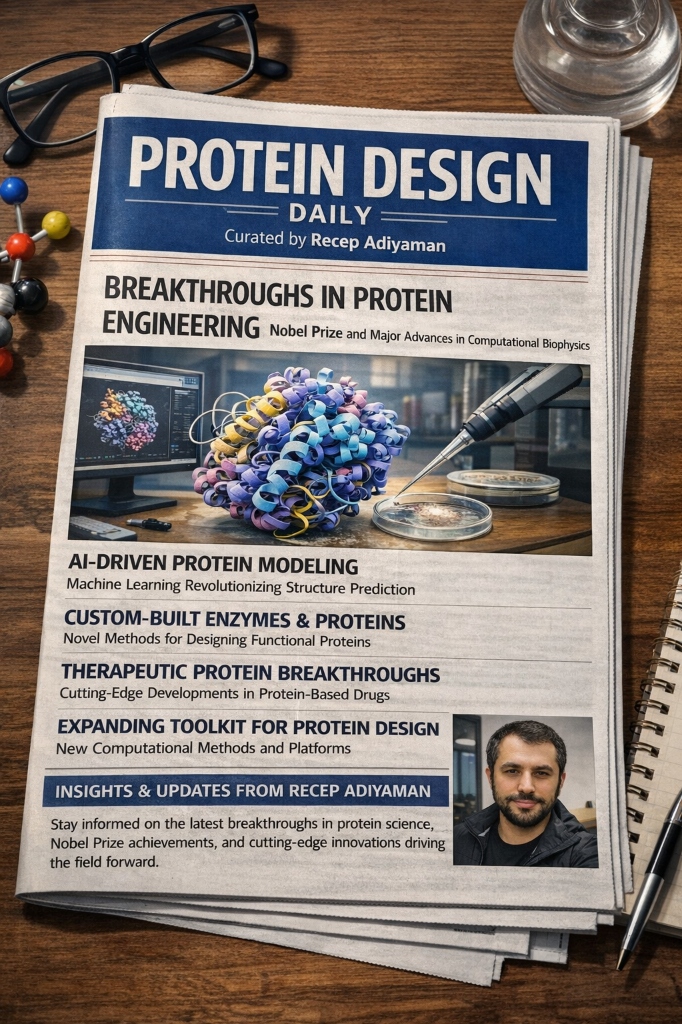
Building something in Protein Design?
I love collaborating on new challenges. Let's build together.
Subscribe to Protein Design Digest
Daily curated signals from arXiv, PubMed, and BioRxiv.
Signal of the Day
From Atoms to Cells: AI-Based Structure Prediction Fueling Molecular Dynamics Simulations in Computational Structural Biology.
The simulation of biological systems has undergone a revolutionary transformation, progressing from modeling single proteins to entire cellular environments. This leap forward is driven by the convergence of molecular dynamics (MD) simulations and artificial intelligence (AI)-powered structure prediction. Traditionally, MD simulations provided atomic-level insights into protein function and interactions, yet their accuracy relied on experimentally determined structures. AI-based models, such as AlphaFold, now enable the rapid and accurate prediction of protein structures, expanding the scope of simulations beyond isolated biomolecules to complex assemblies. However, a structure alone is not sufficient to capture biological function. Molecular motion underlies almost all cellular processes, from enzyme catalysis to signal transduction. MD simulations breathe life into static models, revealing dynamic conformational changes and mechanistic pathways. With computational power and AI capabilities, we are now approaching the long-sought goal of simulating entire cellular processes with unprecedented resolution. This chapter explores how AI and MD are bridging the gap between static snapshots and dynamic cellular models, paving the way for whole-cell simulations. The ability to computationally reconstruct cellular behavior at the molecular scale is poised to transform biological research, drug discovery, and synthetic biology, marking an era in which digital cells become a fundamental tool in scientific exploration.
Why this matters:
Also Worth Reading
Highly accurate protein structure prediction-based virtual docking pipeline accelerating the identification of anti-schistosomal compounds.
Schistosomiasis is a major neglected tropical disease that lacks an effective vaccine and faces increasing challenges from praziquantel resistance, underscoring the urgent need for novel therapeutics. Target-based drug discovery (TBDD) is a powerful strategy for drug development. In this study, we utilized AlphaFold to predict the structures of target proteins from Schistosoma mansoni and S. japonicum, followed by virtual molecular screening to identify potential inhibitors. Among 202 potential therapeutic targets, we identified 37 proteins with high-accuracy structural predictions suitable for molecular docking with 14,600 compounds. This screening yielded 268 candidate compounds, which were further evaluated ex vivo for activity against both adult and juvenile S. mansoni and S. japonicum. Seven compounds exhibited strong anti-schistosomal activity, with HY-B2171A (Carubicin hydrochloride, CH) emerging as the most potent. CH was predicted to target the splicing factor U2AF65, and knockdown of its coding gene Smp_019690 resulted in a phenotype similar to CH treatment. RNA sequencing revealed that both CH treatment and Smp_019690 RNA interference (RNAi) disrupted splicing events in the parasites. Further studies demonstrated that CH impairs parasite viability by inhibiting U2AF65 function in mRNA splicing regulation. By integrating RNAi-based target identification with structure-based virtual screening, alongside ex vivo phenotypic and molecular analyses of compound-treated schistosomes, our study provides a comprehensive framework for anti-schistosomal drug discovery and identifies promising candidates for further preclinical development.
Innovative Approaches in Molecular Docking for the Discovery of Novel Inhibitors Against Alzheimer’s Disease.
Introduction Alzheimer’s disease (AD) is a debilitating neurodegenerative condition marked by progressive cognitive decline and memory impairment, affecting millions worldwide. Despite extensive research, no definitive cure exists, underscoring the need for innovative approaches to drug discovery and development. Methods This review focuses on the application of molecular docking techniques in the context of AD drug discovery. The methodology involves the use of computational modeling tools to predict and analyze the interactions between small drug-like molecules and key protein targets implicated in AD pathogenesis, particularly amyloid-beta (Aβ) and tau proteins. Results Molecular docking has enabled the virtual screening of large chemical libraries to identify potential inhibitors of Aβ aggregation and tau hyperphosphorylation. Numerous studies have validated docking-predicted interactions with in vitro and in vivo experiments, resulting in the discovery of novel compounds with promising pharmacological profiles. Docking has also aided in the optimization of ligand binding affinity and selectivity toward AD-relevant targets. Discussion The integration of molecular docking with experimental techniques enhances the reliability and efficiency of the drug discovery process. Docking allows for the early identification of bioactive molecules, reducing time and cost compared to traditional methods. However, limitations such as rigid receptor assumptions and scoring function inaccuracies require further refinement. Conclusion Molecular docking stands out as a powerful computational tool in the quest for effective AD therapies. Simulating protein-ligand interactions accelerates the identification of potential drug candidates and supports the rational design of targeted interventions, paving the way for future clinical applications in combating Alzheimer’s disease.
Advancing Drug Repurposing for Rheumatoid Arthritis: Integrating Protein-Protein Interaction, Molecular Docking, and Dynamics Simulations for Targeted Therapeutic Approaches.
Background : Rheumatoid arthritis (RA) is a systemic chronic inflammatory autoimmune disease causing progressive joint destruction, resulting in significant morbidity and increased mortality. Despite advances in treatment, current pharmacological options, including NSAIDs, DMARDs, and biological agents, have limitations in tissue repair and can lead to severe side effects. Objectives : This study aims to explore drug repurposing as a viable approach to identify novel therapeutic agents for RA by utilizing existing FDA-approved drugs. Methods : We applied an integrated computational strategy that uniquely combines network pharmacology with molecular docking and dynamics simulations. The process began with the construction of a protein-protein interaction (PPI) network from 2723 RA-associated genes, which identified five central targets: TNF-α, IL-6, IL-1β, STAT3, and AKT1. We then built protein-drug interaction (PDI) networks by screening 2637 FDA-approved drugs against these targets. Critically, the top candidates from this network analysis were not just docked but were further validated using 100 ns molecular dynamics simulations to thoroughly evaluate binding affinity, complex stability, and interaction dynamics. Results : This multi-tiered computational workflow identified Rifampicin, Telmisartan, Danazol, and Pimozide as the most promising repurposing candidates. They demonstrated strong binding affinities and, importantly, formed stable complexes with TNF-α, IL-6, IL-1β, and STAT3, respectively, in dynamic simulations. The key innovation of this study is this sequential funnel approach, which integrates large-scale network data with atomic-level simulation to prioritize high-confidence drug candidates for RA. Conclusions : In conclusion, this study highlights the potential of repurposing FDA-approved drugs to target key proteins involved in RA, offering a cost-effective and time-efficient strategy to discover new therapies.
Research & AI Updates
- HSF1 Modulates Lipid Metabolism and Ferroptosis in Sarcopenia: A Novel Diagnostic Biomarker and Therapeutic Target - Frontiers — HSF1 Modulates Lipid Metabolism and Ferroptosis in Sarcopenia: A Novel Diagnostic Biomarker and Therapeutic Target Frontiers.
- Identifying ecological zones and evaluating plant diversity in the Northwestern Himalayas region - Frontiers — Identifying ecological zones and evaluating plant diversity in the Northwestern Himalayas region Frontiers.
From the Industry
- Layoff Tracker: Charles River, Thermo Fisher Lay Off Staff Amid Site Closures - BioSpace — Layoff Tracker: Charles River, Thermo Fisher Lay Off Staff Amid Site Closures BioSpace.
- Indian Gov’t To Invest $1.1 Bn To Support Biologics & Biosimilars Hub - DCAT Value Chain Insights — Indian Gov’t To Invest $1.1 Bn To Support Biologics & Biosimilars Hub DCAT Value Chain Insights.
- A cut above: Veradermics locks in $256M IPO and shares spike - Fierce Pharma — A cut above: Veradermics locks in $256M IPO and shares spike Fierce Pharma.
- Clinical Trials Market Valuation, ROI Potential & Long-Term Growth Prospects 2026-2036 - morningstar.com — Clinical Trials Market Valuation, ROI Potential & Long-Term Growth Prospects 2026-2036 morningstar.com.
- Eisai strikes Japan licensing deal with Shanghai Henlius Biotech - Reuters — Eisai strikes Japan licensing deal with Shanghai Henlius Biotech Reuters.
- Eisai strikes Japan licensing deal with Shanghai Henlius Biotech - 104.1 WIKY — Eisai strikes Japan licensing deal with Shanghai Henlius Biotech 104.1 WIKY.
- Eikon Therapeutics nets a $381M IPO amid burst of biotech offerings - BioPharma Dive — Eikon Therapeutics nets a $381M IPO amid burst of biotech offerings BioPharma Dive.
Quick Reads
Network pharmacology, molecular docking, and dynamics reveal the mechanisms of Hejie Shengfa Decoction against alopecia areata.
Alopecia areata (AA) is a non-scarring autoimmune disorder characterized by patchy hair loss. Read more →
From Atoms to Cells: AI-Based Structure Prediction Fueling Molecular Dynamics Simulations in Computational Structural Biology.
The simulation of biological systems has undergone a revolutionary transformation, progressing from modeling single proteins to entire cellular environments. Read more →
In Silico Network Pharmacology, Molecular Docking, and Molecular Dynamics Analysis of Rosemary-Derived Compounds as Potential HSP90 Inhibitors for Cancer Therapy.
Cancer remains a major global health challenge, emphasizing the need for new and effective therapies. Read more →
Pioglitazone Mitigates Arsenic-Induced Cardiotoxicity via Lipid Metabolism: Network Pharmacology and Molecular Docking Approach.
Heavy metal exposure is an emerging major environmental risk factor associated with metabolic and cardiometabolic disorders. Read more →
Prediction of the therapeutic mechanism of Sugemule-4 in insomnia treatment using network pharmacology and molecular docking.
This study aimed to identify the active components and related target pathways as well as examine the potential mechanisms of action of Sugemule-4 (SGML-4) for the treatment of insomnia, based on network pharmacology, molecular docking analysis, and molecular dynamics simulation. Read more →
Exploring the mechanism of plasticizers action in liver damage based on network toxicology, molecular docking, and molecular dynamic simulation.
Plasticizers, such as dimethyl phthalate (DMP), diethyl phthalate (DEP), and dioctyl phthalate (DOP), are ubiquitously used in industrial products but pose potential hepatotoxic risks. Read more →
Dihydromyricetin ameliorates vascular dementia by promoting angiogenesis via the VEGFR2 pathway: Network pharmacology, molecular docking and experimental validation.
Background To date, few therapies have proven effective in improving cognitive function in vascular dementia (VD), underscoring the need for new treatment strategies. Read more →
Artificial intelligence in protein-based detection and inhibition of AMR pathways.
Antimicrobial Resistance (AMR) is a global concern demanding high-throughput and precise AMR surveillance strategies. Read more →
Pipeline Tip
Index your BigWig files before visualization to save memory.
Resources & Tools
- Dataset: UniRef - Clustered protein sequence sets for fast similarity searches.
- Dataset: BFD - Big Fantastic Database for deep learning protein modeling.
- Tool: OpenFold - Fast, trainable, and open implementation of AlphaFold2. View all tools →
- Tool: ChimeraX - Next-gen molecular visualization for large data sets. View all tools →
- Event: Structural Biology Events (Open)
The protein structure is the language of life; design is its poetry. — Recep Adiyaman