Issue #117: Assessment of Alphafold Protein Models for Small-Molecule Ligand Docking versus Co-Folding.
Protein Design Digest #117: Assessment of Alphafold Protein Models for Small-Molecule Ligand Docking…
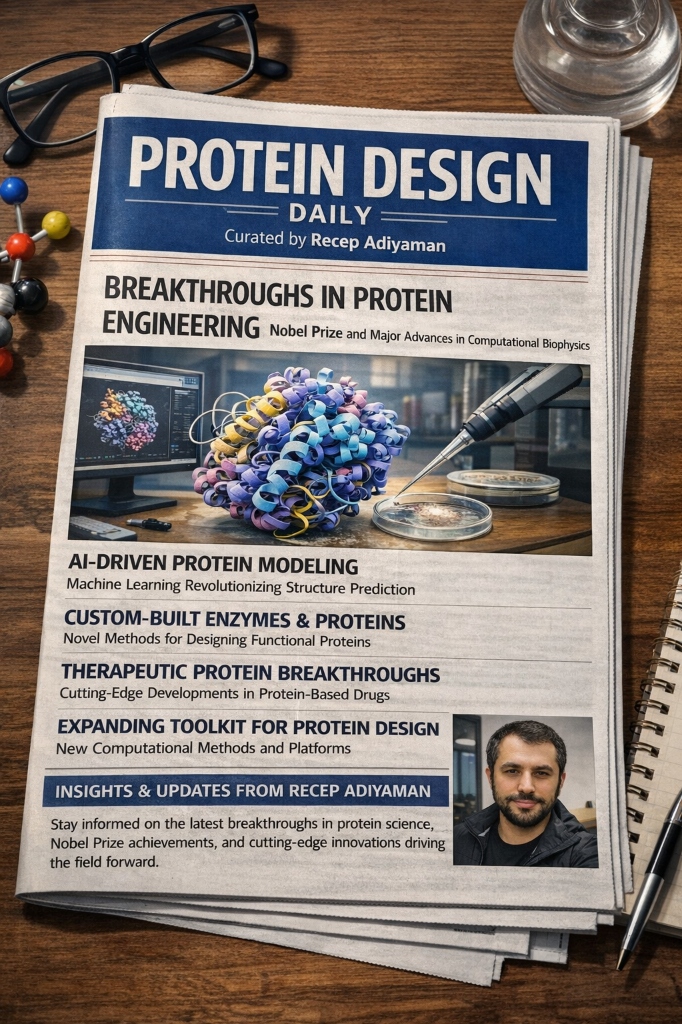
Building something in Protein Design?
I love collaborating on new challenges. Let's build together.
Subscribe to Protein Design Digest
Daily curated signals from arXiv, PubMed, and BioRxiv.
Signal of the Day
Assessment of Alphafold Protein Models for Small-Molecule Ligand Docking versus Co-Folding.
Molecular docking is a powerful computational tool for predicting protein-ligand interactions, widely employed in drug discovery. However, its effectiveness is often constrained by the availability of experimentally determined, high-resolution protein structures, a process that is both time-consuming and resource-intensive. AlphaFold (AF), a machine learning (ML)-based method, offers an efficient alternative by predicting high-accuracy 3D protein structures directly from amino acid sequences. This study assesses the utility of AF-generated protein models for fragment and larger-ligand docking with Glide, which is a widely used docking approach. The docking workflow is evaluated in an unbiased manner by carrying out binding site identification with FTMap, a binding hot spot prediction software. We show that fragment docking to AF models outperforms docking to the respective unbound protein crystal structures and performs comparably to docking to the corresponding ligand-bound structures when using an unbiased approach. Leveraging the computational efficiency of AF model generation, we also employ ensembles of AF models to incorporate protein flexibility. Results show that docking to AF ensembles improves larger-ligand docking compared to docking to singular AF models and outperforms docking to unbound structures. In addition, we compare docking to AF ensembles to co-folding with AF3 and Boltz-2. The results provide insights into the effectiveness of integrating AF protein models into docking procedures, highlighting their potential for streamlining computational drug discovery processes.
Why this matters: Critical for improving fold accuracy and reducing structural uncertainty in de novo design.
Also Worth Reading
Experimental evaluation of AI-driven protein design risks using safe biological proxies
Advances in machine learning are providing leaps forward for beneficial applications of protein engineering, while also raising concerns about biosecurity. Recently, Wittmann et al. described an in silico pipeline of generative AI tools to reformulate sequences of concern (SOCs) as synthetic homologs that may evade detection by biosecurity screening software (BSS) used by nucleic acid synthesis providers. Experimental testing of synthetic homologs is required to ascertain the true severity of this vulnerability. We present a generalizable framework to assess biosecurity risk consisting of testing, evaluation, validation, and verification (TEVV) of AI-assisted protein design (AIPD). We determine that common AIPD models in use at the time this study was initiated (early 2024) are not yet powerful enough to reliably rewrite the sequence of a given protein, while both maintaining activity and evading detection by BSS.
OpenOncology: An Open-Source Framework for Evidence-Based Drug Matching and De Novo Custom Drug Discovery in Precision Oncology
Abstract Background Precision oncology depends on rapid, evidence-based matching of tumor variants to approved therapies. However, two compounding problems limit access for most patients worldwide: first, the interpretation infrastructure remains locked behind institutional subscriptions; second, even well-resourced precision oncology pipelines return empty outputs when no approved or repurposed drug exists for a patient’s specific mutation a complete dead-end that affects the majority of patients with rare or non-hotspot variants. Both problems are structural, not scientific. Methods We present OpenOncology, a fully open-source platform that solves both problems in In the upper you can see it’s left aligned especially in, I think, methods. If we go down in the introduction, everything is center aligned so from front to last it is like a paragraph type like this. sequence. Stage one performs a clinical-grade variant calling workflow (FastQC → BWA-MEM2 → GATK), pathogenicity scoring (AlphaMissense), protein structure prediction (AlphaFold Server), molecular docking (DiffDock), and drug ranking from a weighted composite of OncoKB actionability, OpenTargets evidence, COSMIC frequency, clinical trial phase, and binding confidence. AlphaFold Server and DiffDock are computationally intensive external services; throughput in production deployments is subject to rate limits and available hardware. Stage two triggered when stage one finds no approved or repurposed match executes a fully automated custom drug discovery workflow: it queries ChEMBL and OpenTargets for lead molecules against the patient’s specific target, scores oral bioavailability via Lipinski Rule of Five, generates a mutation specific AlphaFold protein structure, and assembles a manufacturer-ready discovery brief that pharmaceutical companies can bid on through an integrated marketplace. A crowdfunding module enables patients to raise resources for custom synthesis. Results Validation against a blinded 50-case oncologist holdout yielded Hit@3 = 0.900, Standard Precision@3 = 0.508 (ceiling: 0.625), Normalised Precision@3 = 0.817, Mean Reciprocal Rank = 0.883, and zero false-positive recommendations. The 50-case holdout included 12 Level 3–4 literature-sourced cases and 6 negative controls, representing a deliberately harder validation set than smaller prior holdouts; the metric profile reflects increased case difficulty. Stage two (custom drug discovery) validation is structural discovery briefs are verified to contain real ChEMBL and OpenTargets records; clinical validation of lead molecule selection requires experimental binding assays outside the scope of this release. Equivalence-adjusted oncologist concordance reached 100% at both Top-1 and Top-3 across 36 actionable TCGA cases. TCGA benchmarks at 100 and 200 patients demonstrated 100% pipeline coverage with zero empty outputs every patient received either an approved drug recommendation or a structured custom discovery brief. Conclusions OpenOncology is the first open-source precision oncology platform to provide a complete, safe escalation pathway from approved drug matching through to de novo custom drug discovery for patients with no existing therapeutic option. All code, benchmark scripts, and validation artifacts are publicly available at github.com/immortal71/openoncology under the MIT licence.
Network Toxicology, Molecular Docking, and Molecular Dynamics Simulations Reveal the Mechanism of Tetrabromobisphenol A in Bullous Pemphigoid
Bullous pemphigoid (BP) is an autoimmune blistering disease with a growing incidence, and environmental factors are receiving increasing attention. Tetrabromobisphenol A (TBBPA), a widely used brominated flame retardant, is a significant environmental pollutant. However, the molecular mechanisms by which TBBPA contributes to BP pathogenesis remain unclear. This study integrated network toxicology, molecular docking, and molecular dynamics (MD) simulations to systematically investigate the molecular mechanisms of TBBPA-induced BP. Using network toxicology, we identified 797 potential targets of TBBPA and 446 BP-related targets. A Venn diagram analysis revealed 48 common targets. Protein-protein interaction (PPI) network and topological analyses further identified five core hub targets: TNF, CXCL8, MMP9, ICAM1, and ITGB1. Gene enrichment analysis indicated that these targets were significantly enriched in immune-inflammatory pathways, such as leukocyte migration, inflammatory responses, and the IL-17 signaling pathway, as well as in various pathogen infection and cancer-related pathways. Molecular docking revealed that TBBPA stably binds to all five core targets with binding energies ≤ -5 kcal/mol, driven primarily by hydrophobic interactions and π-π stacking. Subsequent MD simulations confirmed that TBBPA complexes with TNF, CXCL8, and MMP9 remained stable throughout the 100 ns simulation. The overall protein structures remained compact, and the ligands were effectively encapsulated within the binding pockets, forming stable networks of hydrogen bonds and hydrophobic interactions. In conclusion, this study, for the first time, proposes a systematic molecular framework using integrated computational biology. Our findings suggest that the environmental pollutant TBBPA may act as a potential risk factor in BP pathogenesis by targeting core proteins (TNF, CXCL8, and MMP9). These interactions potentially disrupt critical signaling pathways related to immune inflammation, cell migration, and tissue remodeling. This study offers a novel mechanistic hypothesis regarding environmental chemical exposure in autoimmune blistering diseases, although further experimental validation is required. Highlights Network toxicology identified 48 common targets linking Tetrabromobisphenol A(TBBPA) exposure to Bullous Pemphigoid (BP). Five core targets (TNF, CXCL8, MMP9, ICAM1, ITGB1) were screened as potential mediators. TBBPA stably binds to TNF, CXCL8, and MMP9 with binding energies ≤ -5 kcal/mol. Molecular dynamics simulations confirm stable binding and structural integrity of complexes. This study provides a mechanistic framework for TBBPA as an environmental risk factor in BP.
Research & AI Updates
- Gemini for Science: AI experiments and tools for a new era of discovery - blog.google — Gemini for Science: AI experiments and tools for a new era of discovery blog.google.
- Breakthrough Discoveries from MSK Research – May 26, 2026 - Bioengineer.org — Breakthrough Discoveries from MSK Research – May 26, 2026 Bioengineer.org.
- Structural biologists are first in world to visualize key cell protein - MSN — Structural biologists are first in world to visualize key cell protein MSN.
- About this collection | Protein Dynamics Informing Structure, Function, and Evolution - Nature — About this collection | Protein Dynamics Informing Structure, Function, and Evolution Nature.
- DKSH Korea’s ATTR-CM drug candidate wins MFDS orphan designation - koreabiomed.com — DKSH Korea’s ATTR-CM drug candidate wins MFDS orphan designation koreabiomed.com.
From the Industry
- As calls for COINS Act expansion grow, will new rules sweep up China biotech licensing? - Fierce Biotech — As calls for COINS Act expansion grow, will new rules sweep up China biotech licensing? Fierce Biotech.
- Biotechnology Market Accelerates Toward USD 6.34 Trillion by 2035 as AI, Gene Editing, and Advanced Biologics Reshape Global Healthcare - BioSpace — Biotechnology Market Accelerates Toward USD 6.34 Trillion by 2035 as AI, Gene Editing, and Advanced Biologics Reshape Global Healthcare BioSpace.
- AI Do: Why the FDA Wants Your Input on AI in Clinical Trials (and Why You Should Give It) - ArentFox Schiff — AI Do: Why the FDA Wants Your Input on AI in Clinical Trials (and Why You Should Give It) ArentFox Schiff.
- Programming biology: next-gen AI firms raise billions to design better medicines - Nature — Programming biology: next-gen AI firms raise billions to design better medicines Nature.
- Why did WOK stock skyrocket nearly 300% in just 2 days? - MSN — Why did WOK stock skyrocket nearly 300% in just 2 days? MSN.
- AI-Designed Miniproteins Target Autoimmune Disease - Technology Networks — AI-Designed Miniproteins Target Autoimmune Disease Technology Networks.
- TaiMed Biologics Completes Phase 2b Enrollment for TMB-365/380 HIV Therapy - The Clinical Trial Vanguard — TaiMed Biologics Completes Phase 2b Enrollment for TMB-365/380 HIV Therapy The Clinical Trial Vanguard.
Quick Reads
Molecular docking approaches in mycetoma: Toward improved patient management.
Mycetoma is a neglected tropical disease characterised by chronic, granulomatous inflammation of the subcutaneous tissues, often leading to disfigurement, disability, and significant socioeconomic burdens. Read more →
Validating the potential mechanism and therapeutic effect of Qinlian Jiangxia decoction in the treatment of type 2 diabetes mellitus complicated with hyperlipidemia through network pharmacology, molecular docking, molecular dynamics simulation, andexperiments.
Objective To investigate the mechanism of action of Qinlian Jiangxia decoction (, QLJXD) in the treatment of type 2 diabetes mellitus (T2DM) complicated by hyperlipidemia using network pharmacology, molecular docking, molecular dynamics simulation and in vivo experiments. Read more →
Exploring the Mechanisms of the Traditional Herbal Formula Sanshen Dan Against Myocardial Ischemia-Reperfusion Injury: An Integrated Strategy Combining Serum Pharmacochemistry, Network Pharmacology, and Molecular Docking.
Objective Myocardial ischemia-reperfusion injury (MIRI) is a critical clinical challenge in cardiovascular disease management. Read more →
Exploring the Vaccine Adjuvant Effect and Mechanism of Epimedium Using Network Pharmacology, Molecular Docking, and Molecular Dynamics Simulations.
Background:Epimedium is a natural herb with immunomodulatory potential, but its vaccine adjuvant properties remain poorly understood. Read more →
A Multistage Virtual Screening Strategy Integrating Molecular Similarity, Deep Learning Scoring, and Molecular Docking toward the Discovery of Novel LRRK2 Inhibitors.
Leucine-rich repeat kinase 2 (LRRK2) has emerged as an attractive molecular target for Parkinson’s disease therapeutics. Read more →
Identification of crucial genes and biological pathways in lung adenocarcinoma by network pharmacology, molecular docking, and simulation studies
Abstract Lung adenocarcinoma (LUAD) remains a leading cause of cancer-related mortality, largely due to chemoresistance treatment-associated toxicity. Read more →
Computational exploration of <i>Aegle marmelos</i> coumarins: DFT, molecular docking, and dynamics studies for anti-hypertensive activity.
Literature reviews indicate that Aegle marmelos exhibits significant anti-hypertensive activity. Read more →
In silico discovery of novel small-molecule PD-L1 inhibitors through a multi-stage computational workflow integrating machine learning and molecular dynamics.
Cancer immunotherapy targeting the PD-1/PD-L1 pathway has transformed modern oncology; however, developing small-molecule inhibitors as viable alternatives to monoclonal antibodies remains a major challenge. Read more →
Pipeline Tip
Normalise thermal B-factors when comparing different crystal structures.
Resources & Tools
- Dataset: PDB-REDO - Optimized protein structure database with refined models.
- Dataset: CATH - Hierarchical protein domain classification for structure and function.
- Tool: ColabFold - Fast AlphaFold2/MMseqs2 pipeline for large-scale predictions. View all tools →
- Tool: RoseTTAFold - End-to-end neural network for protein structure prediction. View all tools →
- Event: Structural Biology Events (Open)
- Event: Protein Design Hub (LinkedIn Group) (Ongoing)
- Job: AbbVie Senior Scientist II, Bioinformatics (Spatial Proteomics and Single Cell Omics) - SmartRecruiters at SmartRecruiters
Deep learning is not a magic wand, but a powerful lens for structural biology. — Recep Adiyaman